No Stopping
Areas where drivers generally must not stop, even briefly.
Last reviewed by NSW Parking Rules editorial team:
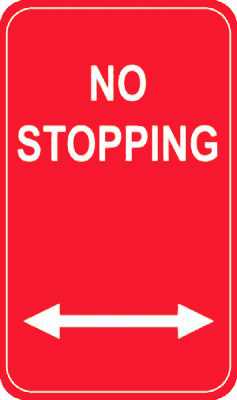
You must not stop in a No Stopping area unless a specific legal exception applies.
If this rule is connected to a fine
Overview
No Stopping restrictions are used where stopping a vehicle can create safety or traffic flow risks. They often appear near intersections, crossings, schools, clearways and busy kerbside areas.
What the rule means
You must not stop in a No Stopping area unless a specific legal exception applies.
Practical details
Official detail
No Stopping is the strictest common kerbside control. It can also be shown by a continuous yellow edge line, so the rule may apply even when there is no upright sign beside your car.
What to check on the street
Look for arrows on the sign, the start and end of any yellow edge line, and whether a time panel limits when the restriction operates.
Everyday example
If a passenger asks to jump out for a few seconds beside a No Stopping sign, keep moving and find a lawful stopping place nearby.
First checks to make on the street
- Read the nearest sign face, including arrows, days and times.
- Look for arrows on the sign, the start and end of any yellow edge line, and whether a time panel limits when the restriction operates.
- A No Stopping sign applies to your side of the road.
- Do not rely on this common shortcut: assuming a very short stop is allowed.
When the rule applies
- A No Stopping sign applies to your side of the road.
- Road markings or arrows show the controlled length.
- A continuous yellow edge line marks a no-stopping area.
- A statutory no stopping rule applies even without a sign.
Examples
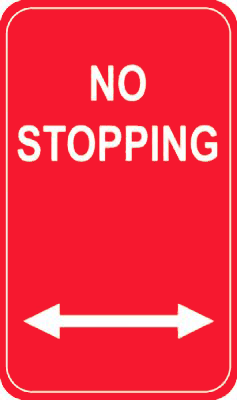
- Stopping to answer a phone call in a signed No Stopping area.
- Letting a passenger out beside a No Stopping sign.
- Waiting beside an unbroken yellow edge line.
- Waiting near a crossing where stopping is restricted.
Common mistakes
- Assuming a very short stop is allowed.
- Only checking the sign in front of the vehicle.
- Ignoring arrows, yellow edge lines and time panels.
Exceptions
- Emergency situations may be treated differently.
- Directions from police or authorised officers can override normal signs.
- Some service vehicles may have specific statutory permissions.
Fines and penalties
Possible penalties depend on the current offence code, location, time and evidence. Check the notice itself and official NSW sources.
What to do if you receive a fine
Read the notice, check the sign and location details, gather photos or permits, then decide whether to pay or request a review.
- Check whether the notice names No Stopping or a related offence.
- Compare the notice time and location with photos of the sign, road marking or kerb layout.
- Keep any permit, ticket, payment record, loading record or written authority if it changes the answer.
- Use Revenue NSW or the authority named on the notice for payment and review steps.
Related parking rules
Related parking signs
Official sources
Use these official sources to confirm the current rule, fine amount, sign wording or local council condition before relying on a parking decision.
- Transport for NSW
Official transport guidance and road user information for New South Wales.
- NSW legislation
Official NSW legislation source for road rules and statutory instruments.
- Revenue NSW
Official source for penalty notices, fine payment and review processes.
General information only.
This guide is independent and does not replace NSW legislation, the sign at the kerb, your penalty notice or advice from the relevant authority.